

ARCHIVE PATRICE VAN EERSEL
Index of previously published articles
French Version
THE WHALES SING WITH HIM
by Patrice van Eersel
First published in ACTUEL N°47, 1983
Jim Nollman, from San Francisco, had already organized concerts with turkeys, wolves, frogs, and rattlesnakes. But his great revelation came from the orcas, in the icy waters of the Canadian Pacific. Dawn was barely breaking when two of these giant dolphins approached him… Within seconds, the musician understood what the scientist John Lilly had been searching for all those years. It was like a flash of enlightenment. An incomprehensible joy flooded over him. If orcas are our spiritual equals, what do they have to tell us?
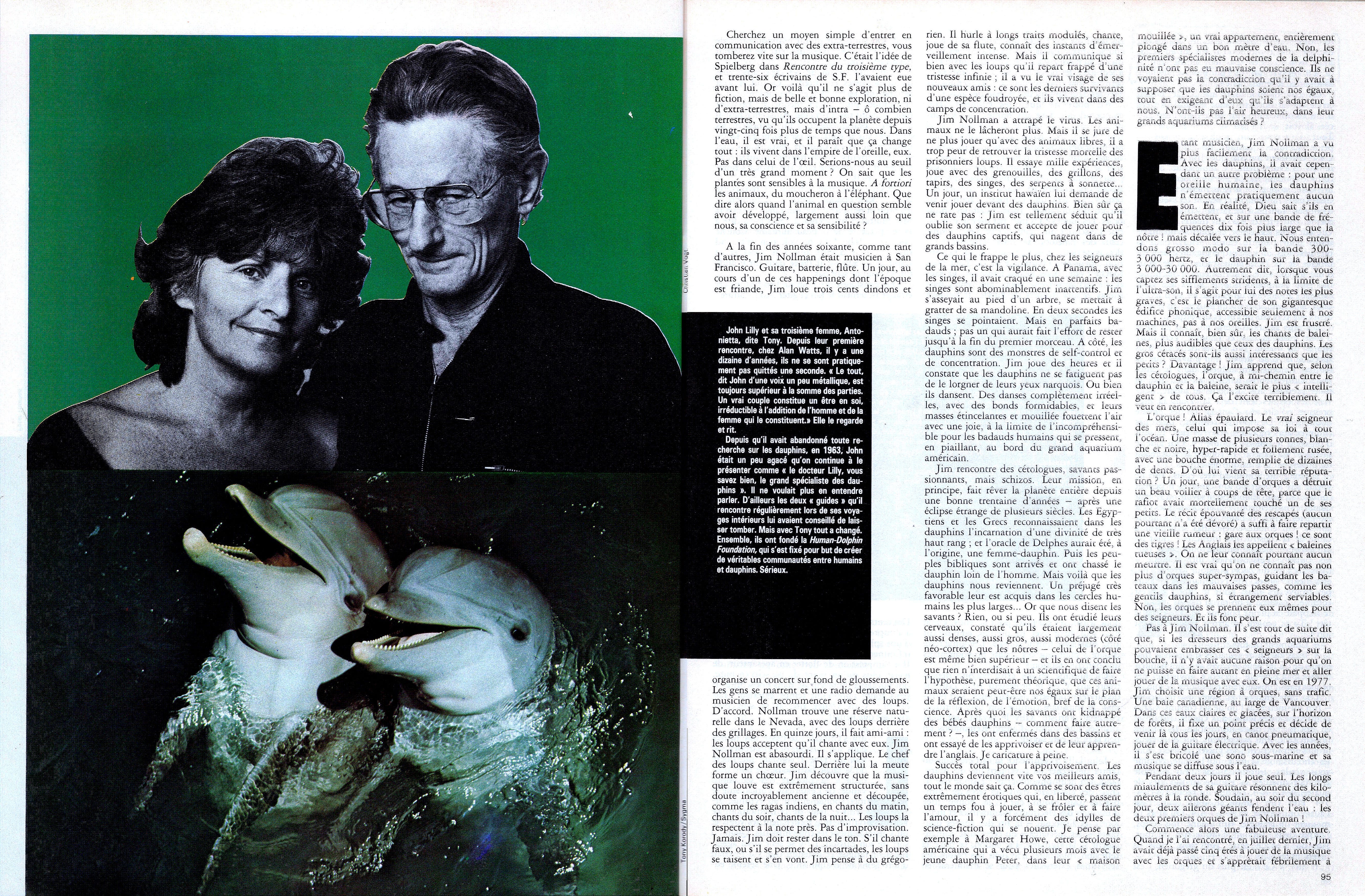
John Lilly and his third wife, Antoinette—known as Tony. Since their first meeting at Alan Watts’s house about ten years ago, they’ve hardly spent a moment apart. “The whole, John says in his slightly metallic voice, is always greater than the sum of its parts. A true couple forms a being in itself, irreducible to the simple addition of the man and the woman who compose it.” She looks at him and laughs.
Ever since he had given up all dolphin research in 1963, John had been a bit irritated that people kept introducing him as “Dr. Lilly—you know, the great dolphin specialist.” He didn’t want to hear about it anymore. Besides, the two “guides” he regularly encountered during his inner journeys had advised him to let it go. But everything changed with Tony. Together, they founded the Human-Dolphin Foundation, whose goal is to create real communities between humans and dolphins. Seriously.
Try to find a simple way to communicate with extraterrestrials, and you’ll quickly stumble upon music. That was Spielberg’s idea in Close Encounters of the Third Kind—and thirty-six science fiction writers had thought of it long before him. But here, it’s no longer fiction. It’s genuine exploration. And it’s not about extraterrestrials, but intraterrestrials—beings profoundly of this Earth, having inhabited the planet twenty-five times longer than we have. In the water, of course—and that seems to change everything: they live in the realm of the ear, not of the eye. Could we be on the threshold of a great moment? It’s known that plants respond to music. Even more so animals—from the gnat to the elephant. So what should we think when the animal in question seems to have developed a consciousness and sensitivity at least as refined as our own?
In the late sixties, like so many others, Jim Nollman was a musician in San Francisco. Guitar, drums, flute. One day, during one of those happenings so typical of the time, Jim rented three hundred turkeys and organized a concert set to their gobbling. People laughed, and a radio station asked him to do it again—with wolves this time. Fine. Nollman found a wildlife reserve in Nevada, with wolves behind fences. Within two weeks, he befriended them: the wolves accepted that he sing with them. Jim Nollman was stunned. He applied himself to it. The lead wolf sang alone; behind him, the pack formed a choir. Jim discovered that wolf music is highly structured—no doubt incredibly ancient—and divided, like Indian ragas, into morning songs, evening songs, and night songs. The wolves followed them note for note. No improvisation. Ever. Jim had to stay in tune. If he sang off-key or took liberties, the wolves fell silent and left. The music reminded him of Gregorian chant. He howled in long, modulated phrases, sang, played his flute, and experienced moments of intense wonder. But his connection with the wolves left him deeply sad: he had seen the true face of his new friends—they were the last survivors of a doomed species, living in concentration camps.
Jim Nollman had caught the virus. The animals would never let him go. But he swore he would only play with free animals from then on—he couldn’t bear to feel again the deadly sadness of the imprisoned wolves. He tried a thousand experiments, playing with frogs, crickets, tapirs, monkeys, rattlesnakes… One day, a Hawaiian schoolteacher invited him to perform for dolphins. Of course, it worked instantly: Jim was so enchanted that he broke his vow and agreed to play for captive dolphins, swimming in large tanks.
What struck him most about these lords of the sea was their vigilance. In Panama, with the monkeys, he had given up after a week—they were unbearably inattentive. Jim would sit at the foot of a tree, strumming his mandolin. Within seconds, the monkeys would appear, curious as could be—but perfect onlookers, none of them willing to stay until the end of the first tune. The dolphins, by contrast, were models of self-control and concentration. Jim would play for hours, and the dolphins never tired of watching him with their sly, glittering eyes. Sometimes they danced—completely unreal dances, full of spectacular leaps, their gleaming, wet bodies slicing through the air with a joy almost incomprehensible to the human spectators crowding and squealing around the big American aquarium.
Jim met cetologists—fascinating, but schizoid scientists. Their mission, in principle, has made humanity dream for more than thirty years—after a strange eclipse lasting several centuries. The Egyptians and Greeks recognized in dolphins the embodiment of a divinity of the highest order, and the Oracle of Delphi, it is said, was originally a dolphin-woman. Then came the biblical peoples, who banished the dolphin from human company. But now the dolphins have returned to us. A very favorable prejudice toward them prevails among wide circles of humanity… And what do the scientists tell us? Nothing—or next to nothing. They have studied dolphin brains and observed that they are just as large, as dense, and as modern (in terms of neocortex development) as ours—indeed, the orca’s is far superior. From this, they concluded that nothing prevented a scientist from making the purely theoretical assumption that these animals might be our equals in thought, emotion—in short, in consciousness. After that, the scientists kidnapped baby dolphins—how else could they proceed?—locked them up in tanks, and tried to tame them and teach them English. I’m hardly exaggerating. Total success in taming: dolphins quickly become your best friends—everyone knows that. Since they are highly erotic beings who, in the wild, spend endless hours playing, touching, and making love, science-fiction-like romances inevitably arose. I’m thinking, for instance, of Margaret Howe, the American cetologist who lived for several months with a young dolphin named Peter, in their “wet house”—a real apartment, entirely flooded with about a meter of water. No, the first modern specialists in “delphinity” didn’t suffer from guilt. They saw no contradiction in assuming dolphins might be our equals while demanding that they adapt to us. Don’t they look happy, after all, in their big air-conditioned aquariums?
Being a musician, Jim Nollman saw the contradiction more clearly than most. With dolphins, however, he faced another problem: to the human ear, dolphins make almost no sound. In reality—God knows they do!—they produce an enormous range of sounds, covering a frequency band ten times wider than ours, but shifted upward. Humans hear roughly between 300 and 3,000 hertz, while dolphins operate between 3,000 and 30,000. In other words, when we catch their shrill whistles, just at the threshold of ultrasound, those are for them the lowest notes—the basement of their immense sonic architecture—audible only to our machines, not our ears.
Jim was frustrated. But of course, he knew the songs of whales—far more audible than those of dolphins. Were the great cetaceans as interesting as the small ones? Even more so! Jim learned that, according to cetologists, the orca—halfway between a dolphin and a whale—was probably the most “intelligent” of all. That thrilled him. He wanted to meet one.
The orca! Also known as the killer whale—the true lord of the seas, who rules over the entire ocean. A massive black-and-white body weighing several tons, lightning-fast and incredibly clever, with a huge mouth full of teeth. Where did it get its fearsome reputation? One day, a pod of orcas rammed and destroyed a beautiful sailboat after it had mortally injured one of their young. The terrified survivors’ account (though none were eaten) was enough to revive an old rumor: beware of orcas—they’re tigers of the sea! The English even call them “killer whales.” Yet, no actual killings are known. Still, there are no reports either of friendly orcas guiding boats out of danger, like the helpful, almost servile dolphins. No, orcas see themselves as sovereigns—and they inspire fear.
But not in Jim Nollman. He immediately thought that if aquarium trainers could kiss these “lords” on the mouth, there was no reason he couldn’t do the same in open water—and play music with them. It was 1977. Jim chose a region known for its orcas, free of boat traffic: a Canadian bay off Vancouver. In those clear, icy waters, framed by forested horizons, he picked a precise spot and decided to return there every day in his inflatable raft to play his electric guitar. Over the years, he had built himself an underwater sound system, letting his music flow beneath the surface.
For two days, he played alone. The long wailing cries of his guitar echoed for kilometers around. Then, on the evening of the second day, two giant fins cut through the water—the first two orcas of Jim Nollman!
Thus began a remarkable adventure. When I met him last July, Jim had already spent five summers playing music with the orcas—and was eagerly preparing to begin a new one.
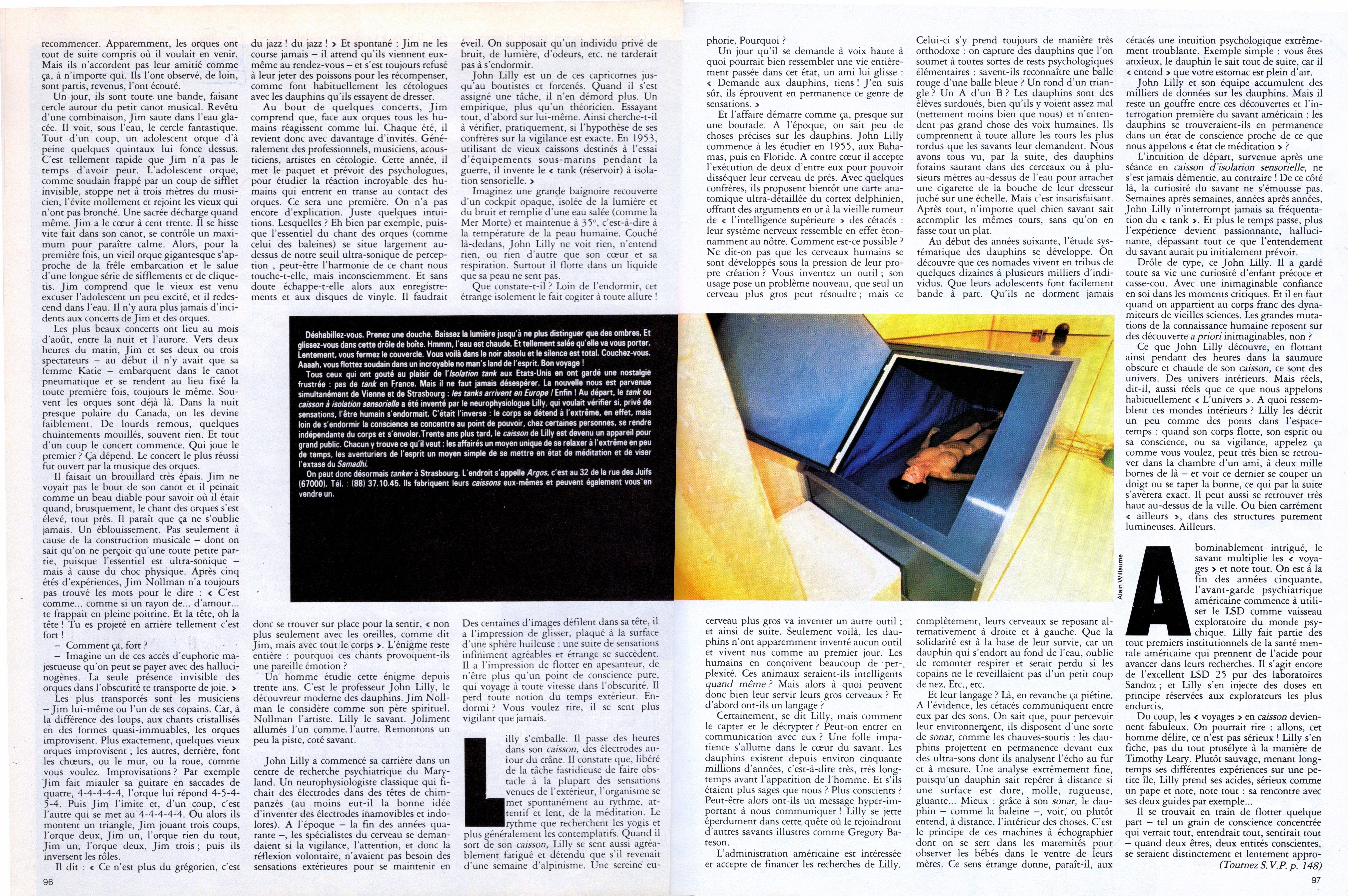
Apparently, the orcas understood right away what he was trying to do. But they don’t give their friendship to just anyone. They watched him from a distance, left, came back, listened. One day, a whole pod surrounded the little musical raft. Dressed in a wetsuit, Jim dove into the icy water. Underneath, he saw the extraordinary circle. Suddenly, a young orca, just a few hundred kilos, charged straight at him. It happened so fast that Jim didn’t even have time to be afraid. Then, as if struck by some invisible whistle, the adolescent stopped short, three meters from the musician, swerved gently, and rejoined the elders, who hadn’t moved. A shock nonetheless—Jim’s heart was pounding at a hundred and thirty beats per minute. He quickly climbed back into his raft, forcing himself to appear calm. Then, for the first time, an enormous old orca approached the fragile boat and greeted him with a long series of whistles and clicks. Jim understood that the elder had come to apologize for the young one’s enthusiasm—and they all sank back into the water. From that day on, there were never any more incidents during Jim’s concerts with the orcas.
The most beautiful concerts take place in August, between night and dawn. Around two in the morning, Jim and his two or three spectators—at first it was only his wife, Katie—set out in their inflatable raft and head to the spot he chose that very first time, always the same. Often, the orcas are already there. In the near-polar Canadian night, you can barely make them out—heavy ripples, a few wet hisses, sometimes nothing. And then suddenly, the concert begins. Who starts first? It depends. The most magical concert was opened by the orcas’ own music.
A thick fog had settled. Jim couldn’t even see the end of his raft and was struggling to get his bearings when, all at once, the song of the orcas rose up, very close. They say it’s something you never forget—an illumination. Not only because of the musical structure—of which we can perceive only a small part, since most of it is ultrasonic—but because of the physical shock. After five summers of experience, Jim Nollman still hadn’t found words to describe it: “It’s like… like a ray of… of love… hitting you right in the chest. And your head, oh, your head! You’re thrown backward, it’s so powerful!”
“How powerful?”
“Imagine one of those majestic rushes of euphoria you can get from hallucinogens. The mere invisible presence of the orcas in the darkness fills you with joy.”
The most transported are always the musicians—Jim himself or one of his friends. Because, unlike wolves, whose songs are crystallized into almost unchangeable forms, the orcas improvise. Or rather, a few old orcas improvise; the others, behind them, provide the choir—or the wall, or the wheel, if you like. Improvisations? For example, Jim makes his guitar wail in bursts of four 4-4-4-4-4. The orca answers 4-5-4-5-4. Then Jim imitates him—and suddenly it’s the orca who switches to 4-4-4-4-4. Or they build a triangle: Jim plays three beats, the orca two, Jim one, the orca none, Jim one, the orca two, Jim three—and then they switch roles.
He says, “It’s no longer Gregorian chant—it’s jazz! Pure jazz!” And spontaneous: Jim never chases them—he waits for them to come to the rendezvous on their own—and he has always refused to toss them fish as a reward, as cetologists usually do when trying to train dolphins.
After a few concerts, Jim realized that all humans reacted to the orcas the same way he did. Each summer, he returned with more guests—usually professionals: musicians, acousticians, artists, and cetologists. This year, he’s going all out, bringing psychologists to study the astonishing reactions of people who fall into a trance in the presence of the orcas. It will be a first.
No explanation yet—just a few intuitions. Which ones? For example, since most of the orcas’ songs (like those of the whales) take place well above our ultrasonic threshold of hearing, perhaps the harmony of their music reaches us subconsciously. And perhaps it eludes recordings and vinyl altogether. One would have to be there to feel it—“not just with your ears,” says Jim, “but with your whole body.”
The mystery remains: why do these songs stir such overwhelming emotion?
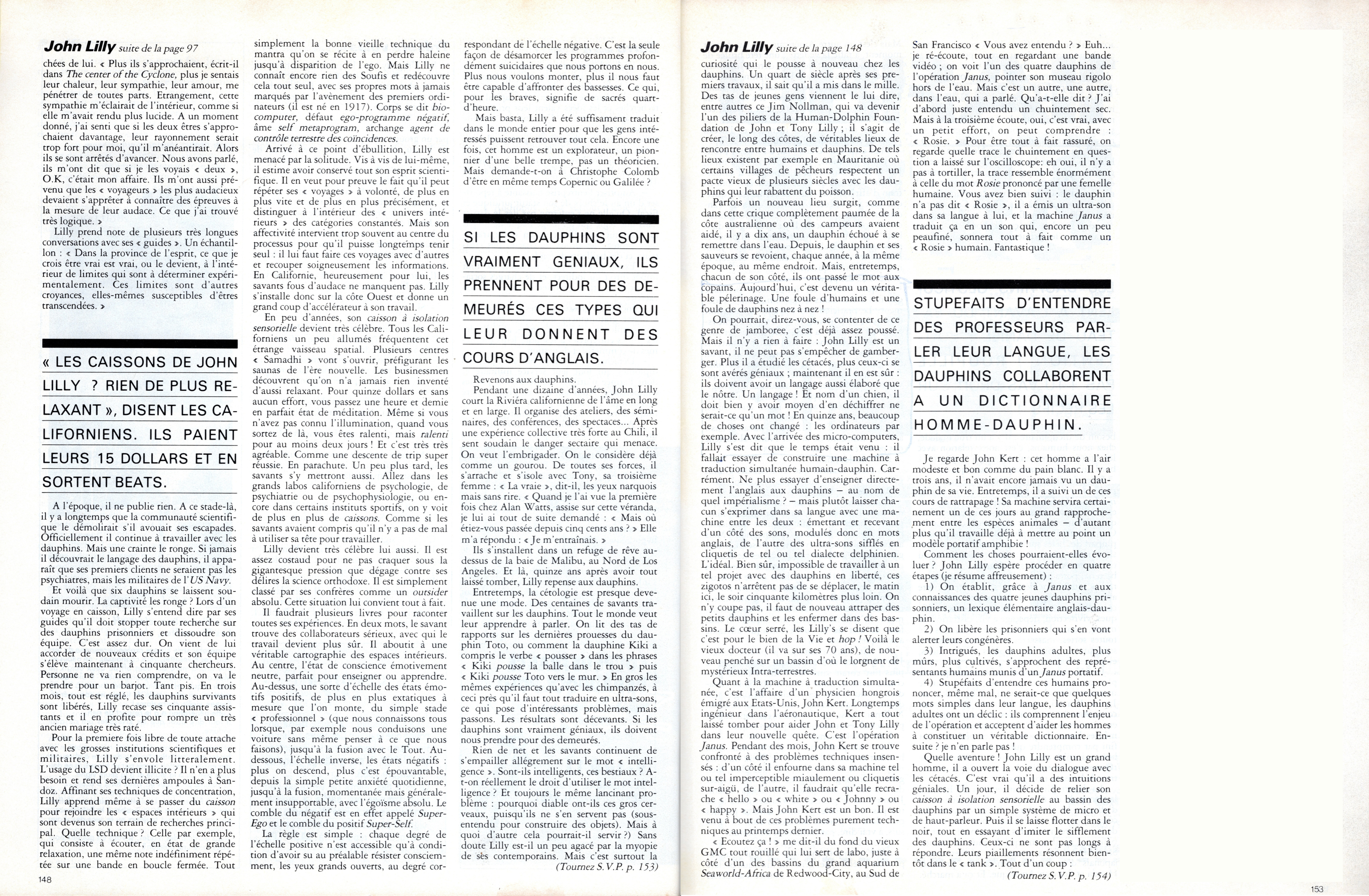
Undress. Take a shower. Dim the lights until you can see only shadows. Then slide yourself into this strange box. Hmmm—the water is warm. And so salty that it will hold you up. Slowly, close the lid. You are now in total darkness, and the silence is absolute. Lie back. Aaaah—you’re suddenly floating in an incredible no man’s land of the mind. Bon voyage!
Everyone who has experienced the pleasure of an isolation tank in the United States carries a lingering nostalgia for it: no tanks in France—until now. But never despair! A new report arrives simultaneously from Vienna and Strasbourg: the tanks are coming to Europe! Finally!
Originally, the tank—or sensory isolation chamber—was invented by neurophysiologist John Lilly, who wanted to test whether, deprived of all sensations, the human being would fall asleep. The result was the opposite: while the body does relax to the extreme, far from falling asleep, consciousness becomes so sharply focused that certain people can detach entirely from their physical body—and fly free.
Thirty years later, Lilly’s chamber has become a device for the general public. Everyone finds what they seek in it: busy people discover a unique way to achieve deep relaxation in a short time; explorers of the mind find a simple way to enter meditation and even approach the ecstasy of Samadhi.
So now, you can “tank” in Strasbourg. The place is called Argos, at 32 rue des Juifs (67000). Tel: (88) 37.10.45. They build their own tanks and can also sell you one.
One man has been studying this mystery for thirty years: Professor John Lilly, the modern discoverer of the dolphins. Jim Nollman considers him his spiritual father—Nollman the artist, Lilly the scientist. Both delightfully eccentric. Let’s trace the story back a bit, on the scientific side.
John Lilly began his career at a psychiatric research center in Maryland. A classic neurophysiologist, he was implanting electrodes into chimpanzees’ heads (at least he had the good idea to invent electrodes that were permanent and painless). At the time—around the late 1940s—brain specialists were asking whether alertness, attention, and therefore conscious thought, required external sensations to remain active. The prevailing assumption was that a person deprived of sound, light, smell, etc., would soon fall asleep.
Lilly was a true Capricorn: relentless, obsessive, and extreme. Once he set himself a task, he never let go. An empiricist more than a theorist, he preferred to test everything—first on himself. He wanted to find out, practically, whether his colleagues’ hypothesis about vigilance was correct. In 1953, using old tanks that had been built to test underwater equipment during the war, he invented the “sensory isolation tank.”
Imagine a large bathtub covered by an opaque cockpit, sealed off from light and sound, filled with salt water (like the Dead Sea) kept at 35°C—the temperature of human skin. Lying in there, John Lilly could see nothing, hear nothing—except his own heartbeat and breathing. Most importantly, he floated in a liquid his skin could no longer feel.
What did he find? Far from making him sleepy, this strange isolation made his mind race! Hundreds of images streamed through his head; he felt as if he were gliding, pressed against the surface of an oily sphere—an endless succession of pleasant and uncanny sensations. He felt weightless, reduced to a single point of pure consciousness traveling at high speed through darkness. He lost all sense of external time. Asleep? Hardly—he felt more alert than ever.
Lilly was elated. He spent hours in his tank, electrodes attached to his skull. He observed that, once freed from the tedious work of filtering external stimuli, the body spontaneously shifted into the slow, attentive rhythm of meditation—the rhythm sought by yogis and contemplatives everywhere. When he emerged from the tank, Lilly felt as relaxed and healthily exhausted as if returning from a week of mountaineering. A serene euphoria. Why?
One day, as he wonders aloud what a whole lifetime spent in that state might feel like, a friend tells him: “Ask the dolphins! I’m sure they constantly feel that way.” And that is more or less how the whole affair begins, almost as a joke. At the time, very little was known for certain about dolphins. John Lilly began studying them in 1955, in the Bahamas and later in Florida. Reluctantly, he agreed to have two of them put down so he could dissect their brains up close. With a few colleagues, he soon produced an ultra-detailed anatomical map of the dolphin cortex, providing golden arguments for the old rumor of the cetaceans’ “superior intelligence”: their nervous system is, in fact, astonishingly similar to ours. How is that possible? Don’t we usually say that human brains developed under the pressure of our own inventions? You create a tool; its use presents a new problem, one that only a bigger brain can solve; but that bigger brain will invent another tool; and so on. Except dolphins apparently never invented any tools, and live as naked as they did on day one. Humans find this deeply perplexing. Could these animals still be intelligent? And if so, what do they need such large brains for? And first of all, do they have a language?
Certainly, Lilly thinks, but how can we capture it and decipher it? Can we communicate with them? A wild impatience catches fire in the scientist’s heart. Dolphins have existed for about fifty million years—meaning a very, very long time before humans appeared. And what if they were wiser than we are? More conscious? Maybe they even have a vitally important message to tell us. Lilly throws himself passionately into this quest, soon joined by other distinguished thinkers such as Gregory Bateson. The American administration takes interest and agrees to fund Lilly’s research.
He proceeds in a very orthodox manner: dolphins are captured and subjected to all kinds of basic psychological tests. Can they tell a red ball from a blue one? A circle from a triangle? An A from a B? Dolphins turn out to be gifted students, even though their eyesight is rather poor (much worse than ours) and they hear very little of human voices. They grasp the trickiest tasks scientists ask of them with remarkable speed. Everyone has later seen trained dolphins jumping through hoops or leaping several meters above the water to snatch a cigarette from their trainer’s mouth as he stands on a ladder. But this is unsatisfying. After all, any performing dog can do similar tricks without causing such a stir.
In the early sixties, systematic study of dolphins expands. Researchers discover that these nomadic animals live in tribes ranging from a few dozen to several thousand individuals. Their adolescents often form their own sub-groups. They never sleep completely, their brains resting alternately on the right and left sides. Solidarity is essential to their survival: a dolphin that falls asleep on the ocean floor may forget to surface to breathe and would be lost if its companions did not nudge it awake with a tap of the snout. And so on.
And their language? That is where things stall. Clearly, cetaceans communicate with one another through sound. We know that, to perceive their surroundings, they use a kind of sonar, like bats: dolphins constantly project ultra-sounds and analyze the echo as it returns. The analysis is extremely precise, since a dolphin can determine at a distance whether a surface is hard, soft, rough, or slimy. Even more: thanks to this sonar, the dolphin—like the whale—sees, or rather hears, the interior of things from afar. It is the same principle used in the ultrasound machines found in maternity wards to observe babies in their mothers’ wombs. This strange sense apparently gives cetaceans an unsettling form of psychological intuition. Simple example: if you are anxious, the dolphin knows immediately, because it “hears” that your stomach is filled with air.
John Lilly and his team accumulate thousands of data points on dolphins. But a chasm remains between these discoveries and the scientist’s primary question: could dolphins exist permanently in a state of consciousness close to what we call meditation?
The intuition that sparked it all—after a session in a sensory-deprivation tank—never faded, on the contrary. Lilly’s curiosity only grows. Week after week, year after year, he never stops visiting the tank. And the more time passes, the more the experience becomes overwhelming, hallucinatory, exceeding anything the scientist’s mind could have initially imagined.
John Lilly was an odd character. He retained throughout his life the curiosity of a reckless, precocious child. An unimaginable confidence in critical moments. And he needed it, belonging as he did to the small band of saboteurs of old sciences. The great shifts in human knowledge rest on discoveries that are, at first glance, unimaginable, don’t they?
What John Lilly discovers, floating for hours in the warm, dark brine of his tank, are universes. Inner universes. But real ones, he insists—as real as what we normally call “the universe.” What do these inner worlds look like? Lilly describes them as a kind of bridge in space-time: when his body floats, his mind or consciousness—call it what you will—may suddenly find itself in a friend’s room two thousand miles away, witnessing that friend cut his finger or roll a good one, events later proven to be true. He may also find himself high above a city. Or quite literally “elsewhere,” inside purely luminous structures. Elsewhere.
Utterly intrigued, the scientist multiplies his “voyages” and notes everything. It is the late fifties; the American psychiatric avant-garde is beginning to use LSD as a vessel for exploring the psyche. Lilly is among the very first institutional figures in American mental health to take acid in order to advance his research. This is still the excellent Sandoz-made LSD-25, and Lilly injects doses normally reserved for the most hardened explorers.
And suddenly the “voyages” inside the tank become extraordinary. One might laugh—come on, this man is hallucinating, this is not serious! Lilly doesn’t care. He is not at all proselytizing in the Timothy Leary style. More of a wild lone researcher, conducting long experiments on a small island, Lilly takes his acid, solemn as a priest, and writes down everything: for example, his encounter with his two guides.
He found himself floating somewhere—like a tiny grain of concentrated awareness that could see, hear, and feel everything—when two beings, two conscious entities, slowly and distinctly approached him.
“The closer they came,” he wrote in The Center of the Cyclone, the more I felt their warmth, their sympathy, their love penetrating me from all sides. Strangely, that sympathy illuminated me from within, as if it had made me more lucid. At a certain point, I sensed that if these two beings came any closer, their radiation would be too strong—it would annihilate me. So they stopped advancing. We spoke. They told me that if I perceived them as ‘two,’ that was fine—it was my own interpretation. They also warned me that the boldest ‘travelers’ must be prepared to face trials in proportion to their courage. Which, I found, made perfect sense.”
Lilly recorded several very long conversations with his “guides.” Here’s a sample: “In the province of the mind, what I believe to be true is true, or becomes true, within limits to be determined experimentally. These limits are further beliefs, themselves subject to transcendence.”
At the time, he published nothing. By then, the scientific community would have torn him apart had he confessed his “escapades.” Officially, he continued working with dolphins. But a growing fear haunted him: if he ever succeeded in decoding dolphin language, his first clients would not be psychiatrists—they would be the U.S. Navy.
Then, suddenly, six dolphins let themselves die. Was captivity destroying them? During one of his tank sessions, Lilly heard his guides telling him he must stop all research on captive dolphins and dissolve his team. It was a harsh order. He had just received new funding, and his team now numbered fifty researchers. No one would understand; they’d think he had gone mad. So be it. Within three months, it was done: the surviving dolphins were released, the fifty assistants reassigned, and Lilly took the opportunity to end a long, unhappy marriage.
For the first time, free from all ties to major scientific and military institutions, Lilly quite literally took off. When LSD became illegal, he no longer needed it; he returned his last ampoules to Sandoz. Refining his concentration techniques, he even learned to do without the tank, entering the “inner spaces” that had become his main field of research. His method? For example, listening in deep relaxation to a short tape loop repeated endlessly—a simple form of the old mantra technique, chanted until the ego dissolves. But Lilly knew nothing yet of the Sufis; he rediscovered all this on his own, using his own language forever marked by the rise of early computers (he was born in 1917): the body as a “bio-computer,” the ego as a “negative program,” the soul as a “self-metaprogram,” the archangel as an “Earth coincidence control agent.”
At this point of inner boiling, Lilly was threatened by solitude. He believed he had retained his scientific rigor—he could repeat his “voyages” at will, increasingly fast and precisely, and could identify constant categories within these “inner universes.” Yet his emotions interfered too often for him to continue alone. He needed to make these journeys with others, to cross-check the data. Fortunately, in California, there was no shortage of daring “mad scientists.” Lilly settled on the West Coast and gave his work a massive new push.
Within a few years, his sensory isolation tank became famous. Every half-enlightened Californian came to try this strange spacecraft. Several “Samadhi centers” opened, precursors to the saunas of the New Age. Businessmen discovered that nothing had ever been invented that was so relaxing. For a dozen dollars, and without any effort, you could spend an hour and a half in perfect meditation. Even if you didn’t reach illumination, when you came out you were slowed down—slowed down for at least two days! And it felt wonderfully pleasant, like the soft landing after a perfect trip—by parachute.
Soon, scientists joined in too. In the major Californian laboratories of psychology, psychiatry, psychophysiology—and even in some sports institutes—one began to see more and more tanks. As if the researchers had realized there was no harm in using one’s head to work on oneself.
Lilly, too, became famous. He was strong enough not to crack under the immense pressure of orthodox science pushing back against his “delusions.” His colleagues simply classified him as an absolute outsider—a label that suited him perfectly.
It would take several books to recount all his experiments. In short, the scientist found serious collaborators, which made his work more reliable. He arrived at a genuine cartography of inner spaces. At the center lay a state of emotionally neutral consciousness—ideal for teaching or learning. Above it, a kind of ladder of positive emotional states, increasingly ecstatic as one ascends, from the simple “professional” mode (that state we all know when, for instance, we drive a car without thinking about what we’re doing) to the fusion with the All. Below it stretched the inverse ladder—negative states: the lower one descends, the more dreadful it becomes, from mild daily anxiety to the momentary but nearly unbearable fusion with absolute selfishness. The summit of the negative he called the Super-Ego, and the peak of the positive, the Super-Self.
The rule was simple: each level on the positive ladder is accessible only if one has consciously, with eyes wide open, faced the corresponding level on the negative side. That is the only way to deactivate the deeply suicidal programs we carry within us. The higher one wants to rise, the more one must be able to confront one’s own darkness—which, for the brave, means some very rough passages indeed.
But enough—Lilly has been translated all over the world, and anyone interested can easily find all this for themselves. Once again, he’s an explorer, a true pioneer, not a theorist. After all, would we expect Christopher Columbus to have been Copernicus or Galileo at the same time?
Let’s return to the dolphins.
For about ten years, John Lilly roamed up and down the Californian Riviera of the soul. He organized workshops, seminars, conferences, performances… After a particularly intense collective experience in Chile, he suddenly sensed the sectarian danger closing in. People wanted to recruit him; they already saw him as a guru. With all his strength, he pulled away and withdrew into solitude with Tony, his third wife—“the real one,” he says, his eyes mischievous but without smiling. “When I first saw her at Alan Watts’s place, sitting on that veranda, I immediately asked her: ‘Where have you been for the last five hundred years?’ She answered, ‘Training.’”
They settled in a dreamlike retreat overlooking Malibu Bay, north of Los Angeles. And there, fifteen years after having abandoned everything, Lilly began to think again about dolphins.
In the meantime, cetology had practically become fashionable. Hundreds of scientists were studying dolphins. Everyone wanted to teach them to speak. There were endless reports about the latest feats of the dolphin Toto, or how the female dolphin Kiki had understood the verb “to push” in the sentences “Kiki pushes the ball into the hole” and “Kiki pushes Toto toward the wall.” Essentially, the same experiments as with chimpanzees—except that everything had to be translated into ultrasonic frequencies, which created some interesting complications, but never mind.
The results were disappointing. If dolphins are truly brilliant, they must think we’re idiots.
Nothing conclusive—and the scientists kept arguing endlessly over the word intelligence. Are these animals intelligent? Do we even have the right to use the word intelligence? And always the same nagging question: why on earth do they have such large brains if they don’t use them (meaning, to build things)? What else could those brains be for?
Lilly was no doubt irritated by his contemporaries’ short-sightedness—but above all, curiosity drove him back to the dolphins once again.
A quarter of a century after his first experiments, Lilly knows he was right on target. Dozens of young people come to tell him so—among them Jim Nollman, who will become one of the pillars of the Human-Dolphin Foundation founded by John and Tony Lilly. Their goal: to create genuine meeting places along the coasts where humans and dolphins can interact freely. Such places already exist, for example, in Mauritania, where certain fishing villages have honored a centuries-old pact with dolphins who help them herd fish toward their nets.
Sometimes a new meeting place appears spontaneously, as in a remote cove on the Australian coast where, ten years ago, a group of campers helped a stranded dolphin back into the water. Ever since, the dolphin and its rescuers meet again each year, at the same time, in the same spot. Meanwhile, word has spread—on both sides. Today, it’s become a true pilgrimage: a crowd of humans and a crowd of dolphins face to face!
You might think that such encounters would be enough—that this kind of “jamboree” already pushes the limits far enough. But John Lilly can’t help himself: he’s a scientist, and his mind never stops working. The more he has studied cetaceans, the more extraordinary they have appeared. Now he’s certain: they must possess a language as sophisticated as ours. A language! And surely, there must be a way to decipher at least a single word of it!
Fifteen years have changed a lot of things—especially computers. With the arrival of microcomputers, Lilly realized the time had come: he would try to build a human–dolphin simultaneous translation machine. Why not? No more attempts to teach dolphins English—what cultural imperialism that would be!—but instead, let each species speak its own language, with a machine in between: on one side, receiving and emitting human words; on the other, processing the high-pitched whistles and clicks of one or another dolphin dialect. The ideal solution.
Of course, it’s impossible to work on such a project with wild dolphins—those wanderers never stay still, here in the morning, fifty kilometers away by nightfall. There’s no way around it: once again, young dolphins had to be captured and kept in tanks. Heavy-hearted, the Lillys told themselves it was for the greater good of Life—and off they went. So there’s the old doctor—now nearing seventy—back beside a pool, watched by mysterious intra-terrestrials.
As for the translation machine itself, that’s the work of a Hungarian-born physicist who emigrated to the United States: John Kert. For years he worked as an aerospace engineer, but gave it all up to help John and Tony Lilly in their new quest. They call it Operation Janus.
For months, Kert wrestled with absurdly complex technical problems: on one side, he fed into his machine some barely perceptible squeak or ultra-high-pitched click; on the other, it was supposed to output “hello,” or “white,” or “Johnny,” or “happy.” But Kert is a gifted man. By last spring, he had solved the purely technical part of the problem.
“Listen to this!” he told me from the back of his rusty old GMC van that serves as his lab, parked beside one of the tanks at the Seaworld–Africa aquarium in Redwood City, south of San Francisco. “Did you hear that?” Uh… I listened again, while watching a video recording. One of the four dolphins in Operation Janus poked its funny snout out of the water. But it was another one—still underwater—that had spoken. What did she say? At first, I heard only a sharp hiss. But on the third listen—yes, it’s true—with a little effort, you can make it out: “Rosie.”
To be sure, we looked at the oscilloscope trace of the sound. And yes—no doubt about it—the waveform was almost identical to that of the word “Rosie” spoken by a human female voice. You follow me? The dolphin hadn’t said “Rosie” in English—it had emitted an ultrasonic sound in its own language, and the Janus machine had translated it into a tone that, once refined, would sound exactly like a human “Rosie.”
Fantastic!
I look at John Kert: he seems modest, kind, as gentle as fresh bread. Three years ago, he had never even seen a dolphin. Since then, he’s had quite the crash course! His machine will no doubt one day play a key role in bringing animal species closer together—especially since he’s already working on a portable, amphibious model.
How might things evolve? John Lilly hopes to proceed in four steps (I’m summarizing brutally):
Using the Janus system and the knowledge of four captive dolphins, an elementary English–dolphin lexicon is established.
The captives are released, and they go off to alert their kin.
Intrigued, mature dolphins—older, wiser, more cultured—approach the human representatives equipped with portable Janus units.
Astonished to hear these humans, however clumsily, pronounce even a few simple words in their language, the adult dolphins have a revelation: they understand the meaning of the experiment and agree to help humans build a true dictionary. And after that? Well—better not to speculate!
What an adventure! John Lilly is a great man—he opened the path to dialogue with cetaceans. He truly has flashes of genius. One day, he decided to connect his sensory isolation tank to the dolphin pool with a simple microphone and speaker system. Then he floated in the darkness, trying to imitate the dolphins’ whistles. They were quick to answer. Their chirps soon echoed inside the tank.
“Imagine, Lilly recounts, a prolonged whistle that enters through your feet and exits through your head—and along its path, somehow makes you aware of the inside of your own body. At one point, I saw—really saw—the interior of my brain, in detail, as the sound came out.”
Explanation? Take your pick. Lilly believes that from their pool, through the bidirectional sound system, the dolphins had simply scanned him—routinely, with their sonar. Only this was the first time he had allowed himself to be scanned while in a state of meditation—the very state, he hypothesized, in which dolphins themselves live twenty-four hours a day. Would that mean that, among cetaceans, communication—even across distance—is infinitely more intimate than ours? As if one could enter another being merely by looking at them? That day, Lilly may well have touched genius. But must we really burden ourselves with a human–dolphin dictionary to reach such ineffable levels of communication? Direct communication, please!
I think of Jacques Mayol—the deepest man in the world—who dives a hundred meters on a single breath. He often spoke of the conventional scientists who loved to use him as a test subject, trying to understand how he could withstand the crushing pressure of the deep. “The doctors stick electrodes on me and thread micro-cameras into my arteries,” he said. “They collect data—but at this rate, they’ll never understand why I need half an hour of yoga before diving to a hundred meters. When I dive, I feel in harmony with the water.”
And now I think of Jim Nollman, the musician of the orcas—the mad herald of a new era. A high-class era. Maestro—music! Everything in music. Life itself in music. Light…
“We must refuse, Jim Nollman says, to be trapped by the trick of the word intelligence, which only serves to measure humans against each other. The mutants should know that no complex machines are needed. The problem lies elsewhere. It isn’t scientific—it concerns everyone. And that’s what the orcas and dolphins are trying to tell us: we humans are sick in our relationship with the other animal species traveling aboard the same planetary ship.”
Bleak essay topic: Describe the place of the animal in modern industrial society. Ugh! A festering wound buried in the collective unconscious, one day bound to explode in humanity’s face. Yes, it stinks. For most creatures that fall under human control, there’s only one fate: extermination—or degradation into grotesque objects of disgust. Battery chickens, water-swollen pigs, “purebred” dogs hopelessly degenerated. And we, with all our “intelligent” technology—slaughterhouses, concentration camps, electric and scientific torture, vivisection, flaying alive, mass castration, chemical straitjackets, and every kind of massacre—anonymous or grandiose—for the so-called noble species: lions, elephants, whales…
Jim Nollman was among those who helped end, little by little, the slaughter of dolphins on Japan’s Iki Island. He spent months there, persuading the local fishermen—who saw the dolphins as competitors for the same schools of fish. Eventually, they understood that the killings were far more costly—in labor and in reputation. The truth was, there were no more fish—too many boats, too big!
Jim had first gone to Iki Island at Greenpeace’s request, tasked with scaring the dolphins away from the Japanese coast by playing underwater recordings of their dying kin. In the end, he achieved more through politics: threatening the Japanese government with a general U.S. boycott of Honda and Sony products. It worked.
But at the last moment, another American stole the spotlight—a reckless Greenpeace activist who cut the nets holding the dolphins destined for slaughter. For Jim, the battle of Iki Island was a nightmare—press conferences, chaos, police, private detectives, blood-red seas. He swore never to get involved in politics again. It was hell.
But now it’s over. Finally. At the very moment I write these words—August 10, 1983, noon—Jim and Katie Nollman, along with their small circle of chosen human ambassadors, are preparing their inflatable raft somewhere along the Canadian coast near Vancouver. In a few hours, a new concert will begin. There’s magic in the air!
At the same moment, three thousand kilometers to the south, John Lilly is floating in his tank, meditating on the same question.
Dolphin dream.
Jacques Mayol is convinced that our descendants will soon “delphinize.” The pioneer working hardest in that direction is the Soviet researcher Igor Tjarkovskij: he has already delivered hundreds of babies underwater, then teaches the newborns to live and play beneath the surface. There’s a Tjarkovskij film at the Human-Dolphin Foundation in California, and photos arriving from Sweden—astonishing images: imagine a strong, perfectly balanced toddler, quietly playing with blocks at the bottom of a pool! Where are we?
And Tjarkovskij also works with Black Sea dolphins—looking for cetacean teachers for his children!
Dolphin dream.
The Sioux once said that the souls of great warriors reincarnate as dolphins.
Dolphin dream.
Go see them. Go listen to them. What haunts me most is the rhythm. If dolphins—or whales—communicate through music, then there must be rhythm, right? And it must be a wild rhythm! Something vast, gathering hundreds of cetaceans into a single “wheel,” as the Zairians say to describe the rhythm that unites a whole village.
And perhaps that, in the end, is what Janus, the translation machine of Lilly and Kert, will truly be for—to transmit to us the collective rhythm of the orcas. We should play good African music for the orcas—just to see what happens…
Before I left, Jim Nollman confided that his most powerful concert will probably take place next year, in the polar waters of northern Canada, where the Beluga whales live—those strange whales with flexible necks. Nollman believes Belugas are even more sensitive and attentive than orcas.
Summer 1984 looks promising.
But one problem remains. If I go to my butcher and say, “Two medium slices of mammal, please—nice and bloody,” people will stare. And they’d be right to. I like the taste of meat—but I don’t kill it myself. I let professionals do it in big, closed buildings. And, honestly, I prefer not to know.
What’s that you say? Become a vegetarian?
Come on—music, music! We have to start over from scratch.
So tell me: what kind of music does your cat like best?
Disclaimer: All archives on this website are protected by copyright. Any reproduction, distribution, or use without prior authorization is strictly prohibited.